• About
  • Disclaimer
  • Links
  • Market Wisdom
  • Practical Wisdom
  • Video/Audio Market Wisdom
  • Video/Audio Practical Wisdom

Zone of Competence

~ Dollars, Sense, and Probabilities.

Zone of Competence

Category Archives: Uncategorized

Inverting the How-to-Invest Question: How Not to Invest?

12 Saturday Jul 2014

Posted by JC in Uncategorized

≈ 4 Comments

Tags

Investing

Difficult problems can sometimes best be solved by inverting them. In the spirit of Carl Jacobi (via Charlie Munger), this post will approach investing by listing what not to do. After all, the first goal should be to do no harm to your portfolio and your financial future.

A great guide in what to avoid is Josh Brown, the Reformed Broker. His writings are referenced liberally in what follows, and his book Backstage Wall Street is must reading to avoid being prey for the con artists and charlatans of the financial world.

Avoid Unnecessary Complexity

Complex financial products and strategies should be avoided, unless you have mastered all of the nuances thereof. Even then, simplicity is usually your friend. Complexity in finance is usually the tool of the pickpocket — think Bernie Madoff and morally ambiguous brokers.

We all would love to think we have found a risk-free way to make 20% annual returns, and many unscrupulous operators will promise you they have found the Holy Grail. Your radar should start pinging if they push a product or strategy with impressive-sounding jargon and impenetrable gobbledygook, whisper of its exclusivity and how lucky you are to be let in on it, or promise high returns with no risk. Just like the magic pill where you can eat all you want and lose weight, this doesn’t exist.

Although we can live in hope that science and technology may one day invent the magic diet pill, high investing returns with no risk will never exist. As Josh points out, “The only reason investing works is because things can go wrong.”

Avoid Private Placements

A crucial category to avoid is any private placement being pushed by a broker. A private placement is not traded on a public exchange. Prime examples to avoid are non-traded REITs and private limited partnerships. Many times the broker pushing these bombs will even use the fact they are non-traded as a selling point, as in, “It’s non-traded, so there is no volatility.”

Josh has done a great service by pointing out these and other murder holes as “investments” to be avoided at all costs. In his words, “Almost every private placement you have ever been pitched or will ever be pitched is a scam.”

Avoid Leverage

Using leverage is a really good way to reduce the likelihood your portfolio will succeed in meeting your long-term goals. Infinite examples exist, but my favorite is the tale of Long-Term Capital Management, a hedge fund run by a bunch of Nobel Prize winning Ph.D.’s. They nearly collapsed the financial system when their leveraged bets behaved in ways their models told them were virtual impossibilities.

As the apocryphal Keynes’ aphorism goes: The market can remain irrational longer than you can remain solvent.

Leveraged and Inverse ETFs are especially to be avoided, as they are intended for daytraders, and are reset daily. These are not to be held long-term, as they will almost surely eventually eat up the lion’s share of your capital.

Avoid Options

Theoretically, money can be made in options with less upfront capital required. What this basically means is that there is inherently high leverage in options. This alone would make me take a pass.

But in addition to the leverage, options add the “feature” of time decay. In other words, you not only have to be right on intrinsic value and your investment thesis, but you have to be spot on in terms of timing. Otherwise your option expires worthless. This isn’t investing, it is speculation.

Only a small fraction of people can do the math and manage their risk in such a manner as to not blow up in this arena. Most of them are probably working at hedge funds, high-frequency trading firms, or doing theoretical physics. If you think you have an edge competing against these people with these constraints, then good luck. As Warren Buffett has said, “If you are at a poker table and can’t figure out who the patsy is, it’s you.”

As for me, investing without the curses of leverage and time decay is complicated enough. If you still want to play with options, then I have a lovely piece of property in Indonesia to sell you.

Avoid Exotic New Products

In this category would go structured notes and liquid alts. Structured notes are a new and opaque way to promise the moon for free while charging high fees and hiding risks from the buyer. Liquid alts are piggy-backing on whatever is new and hot such as long-short hedge funds or or Ray Dalio-esque risk parity type strategies. Both of these are the triumph of marketing over investing sense.

In addition to these legitimate but unneeded innovations, there are also all sorts of frauds out there using exotic supposed “securities.” As one example, I’ve heard of promissory note frauds which have snared a lot of people.

There are a lot of affinity frauds where charismatic sociopaths prey on members of their own church or other social group. Many examples of these and other frauds can be seen on the CNBC series American Greed. This is one program on CNBC that is actually likely to benefit investors. Caveat emptor people.

Avoid Penny Stocks

Another area of mischief is penny stocks. Sometimes referred to as trading in the Pink Sheets, fraud and manipulation is the backbone of this area of the market. Very rarely a real successful company will emerge from here, but this is about as rare as winning the lottery.

This was the home of the fraudulent IPO pump-and-dump schemes of Jordan Belfort, whose story is featured in the movie The Wolf of Wall Street.

A current example of fraud in penny stocks is Cynk Technology. The price of CYNK was up 24,000% or so in a month before regulators started asking questions about the supposed social-networking site that has no revenues and only 1 employee.

Avoid High Costs, High Turnover, and Tax Inefficiency

High cost products and strategies are the bane of good investment performance. Jack Bogle has been huge in noting this and helping individual investors avoid the high-cost trap. His Cost-Matters Hypothesis was revolutionary when he started the Vanguard S&P 500 Index fund, but has since become accepted wisdom.

High turnover is also to be avoided because the increased trading costs and resulting tax inefficiency can add up to a double whammy against your portfolio. Tax inefficiency applies if the high turnover takes place in a taxable account. As Charlie Munger has said, the difference over long time periods can be “truly eye-opening.”

Keep any high turnover activity in a tax-favored account like an IRA or 401(k). As Michael Batnick points out, even the greatest trader in the world can’t beat an index fund after tax in a taxable account.

If You’re So Smart, How Come You’re Not Rich?

13 Friday Jun 2014

Posted by JC in Uncategorized

≈ Leave a comment

Tags

Investing

It’s remarkable how ill-suited we advanced primates are to investing. We like to think we are smart and rational when it comes to managing money, but study after study has shown that we tend to buy after the market has gone up and sell when it has gone down.

Being social animals, it is extremely hard for us to be outside the herd. By definition, following the market is following the herd. While social proof can be beneficial in many other phases of life by keeping you from behaving like a deviant in one manner or another, it is the enemy of investing well, at least at extremes of valuation and crowd sentiment.

Invs Willingness to take risk

The investor’s chief problem – and even his worst enemy – is likely to be himself.
– Benjamin Graham

Don’t Trust Your Instincts

The reality is that contrary to the nostrums of the self-help movement, you can’t trust your emotional instincts when it comes to investing. You need to cultivate an intellectual outsider’s mentality and pair it with becoming comfortable zigging when your mood tells you to zag.

Most people can’t or won’t do this because of the difficulty of being different from the crowd.

When markets are happy, think about what could go wrong. When markets are in despair, think about what could go right. — Dennis Stattman

What If You Can’t Develop an Outsider’s Mentality?

If you can’t cultivate this outsider’s mindset, you either need a brain-dead-simple strategy where you commit to a certain asset allocation and rebalance when the percentages get out of whack, or you need an adviser who will talk you down off of the ledge before you sabotage yourself. This is one area where a good adviser can be worth his or her weight in gold.

The most important lesson in investing is humility.
– Sir John Templeton

Keep it Simple, Smartie

One of the lessons of military strategy is to attack where your opponent is the weakest. With so many smart people running money, you shouldn’t try to compete with their strengths. Short-term trading and very complex strategies are areas where it is going to be very hard to get an edge on all of the other smart guys out there.

Don’t try to out-clever all of the CFAs and hedge fund guys. Since most of the pros are focused on the short-term, the individual investor should focus on lengthening their time horizon and being patient. Simple strategies that you are committed to in good times and bad will work over time.

It is remarkable how much long-term advantage people like us have gotten by trying to be consistently not stupid, instead of trying to be very intelligent.
– Charlie Munger

Can You Handle The Truth About Your Flaws As An Investor?

24 Saturday May 2014

Posted by JC in Uncategorized

≈ Leave a comment

Tags

Charlie Munger, Investing

All human beings are deeply flawed and are susceptible to a multitude of cognitive biases and irrational behaviors. To be a great investor, you must examine your flaws so you can seek to counter them. Three great guides on this journey are Charlie Munger, Jason Zweig, and Guy Spier.

Charlie Munger: The Psychology of Human Misjudgment

The following audio recording of a speech Charlie Munger gave to an audience at Harvard around 1995 is a great place to begin. It is an hour and 16 minutes long, but a great introduction to Munger. I devour everything I can from him.

The Pyschology of Human Misjudgment: Speech by Charlie Munger

Jason Zweig and Guy Spier

Jason Zweig is another great guide on this journey to knowing yourself and your flaws. His book Your Money and Your Brain is a classic and a must read for the serious investor.

Jason’s column in the Wall Street Journal is a great short-form introduction to his thinking. His latest column, Giving Yourself an Investing Makeover, introduces us to a great investor and courageous seeker of the truth, Guy Spier. I say courageous because his rigorous honesty in publicly naming his own flaws is amazing in this age of “experts” who pretend they have all of the answers all of the time.

From the article:

In a book to be published in September by Palgrave Macmillan, ‘The Education of a Value Investor,’ Mr. Spier describes his struggle to improve his decision-making hygiene.

Seldom has a successful money manager so painfully flagellated himself in public. In the book, Mr. Spier calls himself ‘blind,’ ‘dumb,’ ‘spectacularly foolish,’ ‘misguided,’ ‘stumbling,’ ‘wrong,’ ‘vulnerable’ and, over and over again, ‘irrational.’

‘We think we control our environment, but in fact it’s our environment that controls us,’ Mr. Spier told me. ‘We can’t change the world. The only thing we can change is ourselves, by trying to get a better understanding of our own messed-up wiring.’

The Courage to Seek and See the Truth About Yourself

Do you have the courage to see the truth about your flaws as a human being and an investor? To me, the really great investors are the ones who examine their own flaws and seek to correct for them.

The vices we scoff at in others laugh at us within ourselves.
— Sir Thomas Browne

Offense or Defense?

27 Sunday Apr 2014

Posted by JC in Uncategorized

≈ Leave a comment

Tags

Investing

Do You Think Buffett Has Lost It?

Some have suggested that Warren Buffett has lost it, as he trails the S&P 500 over the last 5 years. But Ben Carlson shows that historically Buffett has really outperformed during the downturns.

BuffettV.S&P March 2014

“The best investors do not target return; they focus first on risk, and only then decide whether the projected return justifies taking each particular risk.
— Seth Klarman

Are You Chasing the High-Fliers?

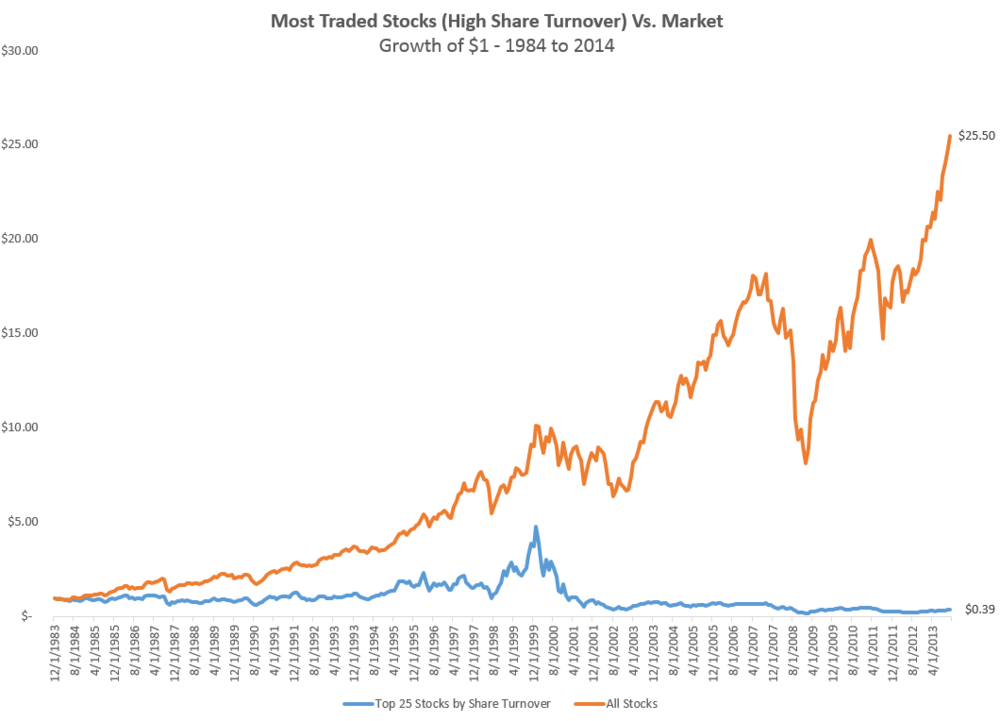
Do you own popular stocks like Twitter, Tesla and Netflix? If so, you shouldn’t expect much from your portfolio, according to Patrick O’Shaughnessy at Millenial Invest. Measuring popularity by high share turnover, the most popular stocks have tended to badly underperform the market.

MostTradedStks

This isn’t surprising, as their popularity makes them expensive in good times and they tend to get hit harder in downturns. As O’Shaughnessy notes, you are generally better off avoiding these stocks. As an added bonus, doing so will give your portfolio a value tilt.

“Success in investing is not a function of what you buy. It’s a function of what you pay.”
– Howard Marks

Do You Think You Can Identify the Big Winners in Advance?

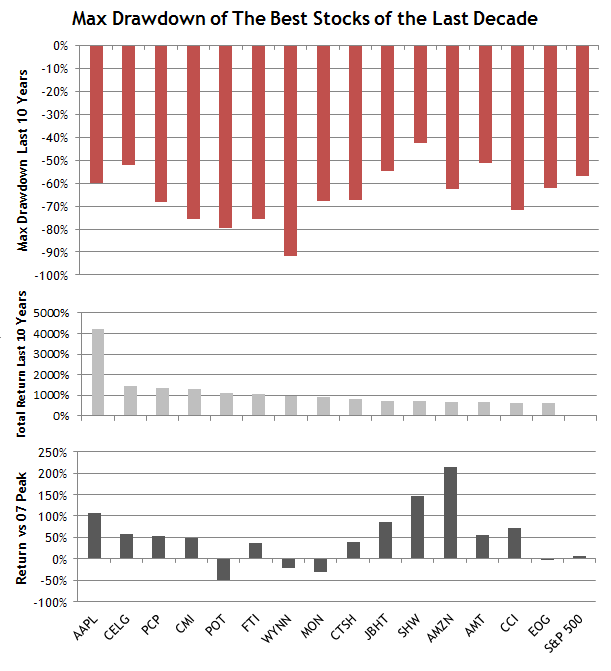
This chart from Scott Krisiloff shows the downside volatility of the biggest winning stocks over the last decade, as of summer 2013.

MaxDrawdownofBestStks July 2013

These are great returns, but would you have held on when they had drawdowns of 60% to 90%? If you are going to invest in the exciting, go-go stocks, you better have a strong stomach. And are you really sure you can identify the long-term winners in advance and discard the flameouts? Good luck with that, but this isn’t the game I play.

“If investing is entertaining, if you’re having fun, you’re probably not making any money. Good investing is boring.”
– George Soros

Defense Wins Championships

Remember the saying defense wins championships. A la Warren Buffett, this sports truism works in investing, too. Don’t forget the math of drawdowns.

MathofDeclines

“Ultimately, nothing should be more important to investors than the ability to sleep soundly at night.”
— Seth Klarman

Current Thoughts

17 Thursday Apr 2014

Posted by JC in Uncategorized

≈ 1 Comment

Tags

Investing

Seasonality tendencies are about to go negative

The end of the market’s best six months is fast approaching — also known as “Sell in May.” Mid-term election years intensify this effect. So weakness in the next 6 months wouldn’t be at all surprising.

Things are still a bit frothy and many of my watch list stocks are becoming less and less attractive for new purchases.

Between not being able to find much that is cheap enough to buy and the weak seasonality, I’m updating my watch list and holding some cash so I can take advantage of any opportunities that may come my way in the next few months.

Longer Term Things Still Look Good

Jeff Saut thinks we are in a secular bull market. If so, pullbacks are for buying.

Bob Shiller thinks the odds of a recession any time soon are very low. Recessions usually end bull markets. Score one for the bulls.

AveWkWknorecesh 040914

What If We Have a Bear Market?

What happens if we have a bear market? It’s usually better to wait it out, according to Sam Stovall. sam-stovall-sp-capital-iq 0414

Always Be Mindful of Risk

This chart shows the percentage gains needed to recover from losses of different magnitudes.

MathofDeclines

Don’t confuse activity with productivity

So there are risks. Nothing is automatic and easy. But if you can find some fairly-priced great company and buy it and sit, that tends to work out very, very well indeed especially for an individual. — Charlie Munger

Patience is the individual investor’s greatest advantage over the market.
— Todd Wenning

← Older posts
Newer posts →

Recent Posts

  • Climate Lunacy Continues Despite Inconvenient Truths
  • Reason in the Internet Age: How you can avoid getting stampeded into poor conclusions and buying into silly conspiracy theories
  • Climate Change is a Real Problem, but Current Renewable Energy Technologies Can’t Replace Fossil Fuels Without a Huge Nuclear Buildout. Because, Physics.
  • Larry Fink’s Convoluted & Coercive Solution to the Problems of Indexing
  • The Wisdom of Charlie Munger: You Have a Moral Duty To Be Rational and Reasonable, and To Eliminate Your Own Ignorance

Archives

  • October 2021
  • November 2020
  • August 2019
  • January 2018
  • December 2017
  • November 2017
  • July 2017
  • June 2017
  • January 2017
  • July 2016
  • May 2016
  • April 2016
  • March 2016
  • February 2016
  • December 2015
  • November 2015
  • August 2015
  • June 2015
  • April 2015
  • October 2014
  • September 2014
  • August 2014
  • July 2014
  • June 2014
  • May 2014
  • April 2014
  • March 2014
  • February 2014
  • January 2014
  • December 2013
  • November 2013
  • October 2013

Categories

  • Uncategorized

Meta

  • Create account
  • Log in
  • Entries feed
  • Comments feed
  • WordPress.com

Blog at WordPress.com.

  • Subscribe Subscribed
    • Zone of Competence
    • Join 28 other subscribers
    • Already have a WordPress.com account? Log in now.
    • Zone of Competence
    • Subscribe Subscribed
    • Sign up
    • Log in
    • Report this content
    • View site in Reader
    • Manage subscriptions
    • Collapse this bar
 

Loading Comments...