Jeff Saut’s Key to Getting Rich Slowly: Look at Risk, Not Just Reward

Tags

, ,

Jeff Saut revisits some wisdom from Richard Russell and adds his own twist:

In the world we live in, few look at risk. Most only look at reward. The few who do look at risk (the educated, the street savvy) make their money at the expense of the great unwashed majority who swallow the noise nonsense about getting rich quick. Investing is a get rich slowly process. You have to put your money at risk in the face of uncertainty. Emotions run rampant before the uncertainty of floating, fluctuating, often violent and volatile markets. Constantly discounting prices are fickle and full of surprises.

Therefore, when you consider straying away from a compounding type of investment make sure you understand risk and that you get value and a margin-of-safety price concession. Maybe John Burr Williams, a pioneer in the concepts of modern portfolio theory, said it best, ‘The value of any stock, bond or business is determined by the cash inflows and outflows, discounted at an appropriate interest rate, which can be expected to occur during the remaining life of the asset.’

This isn’t as sexy and fun as chasing the latest hot fads, but it is what gives smart, successful, long-term investors their edge. Like Warren Buffett has said, Rule #1 is don’t lose money. Rule #2 is refer to Rule #1.

Jeff’s whole commentary is well worth a read:
“Rich Man, Poor Man!”

Risk Management and Psychology

Tags

Investing well requires you to be fairly numerate and to stay within your (hopefully expanding) circle of competence. Beyond that, risk management is key.

I often describe my manner of investing as a risk-management approach. My first duty to myself as an investor is not to blow up my portfolio when the market goes against me. I must live to fight another day. The usual risk management tools are all useful: diversification, asset allocation, seeking a margin of safety, behaving like a business owner (not a renter), seeking businesses with economic moats, keeping an eye on valuation, addressing the sleep-at-night factor during good times, and keeping a long-term orientation. These are all necessary, but not sufficient.

The biggest risk to manage is the risk of emotional self-sabotage. You can count on the fact that a big decline will make you want to sell to stop the pain. This fight-or-flight response was evolutionarily useful to avoid predators, but it is disastrous if obeyed in investing. This is why psychological self-knowledge and managing my emotions is a key part of my risk-management approach. Being aware of this tendency to self-sabotage and building an intellectual and emotional bulwark against it is some of the most important work that an investor can do. This is what Ben Graham was onto when he said, “The investor’s chief problem – and even his worst enemy – is likely to be himself.”

It is human nature to want to sell when the market is going down and buy when it is going up. Accept that, but build in the self-knowledge and safeguards to your process to keep yourself from snatching defeat from the jaws of victory.

All else being equal, unless some fundamental deterioration of the business has happened, you should like it more when it is cheaper than when it is expensive. If you are properly prepared, a selloff brings the possibility to profit from the irrationality of others.

Thoughts for the New Year

Tags

,

In my previous post “Charlie Munger and the Miracle of Tax-Efficient Compounding,” I mentioned the importance of maximizing your after-tax return, but I failed to complete the thought. There are 2 great ways to do this: 1). Invest in a tax-advantaged account like an IRA or 401(k), and 2). With your taxable money, invest in a low-turnover index fund or in high-quality individual stocks and hold them long term.

***********************************************

I am a big fan of Morningstar. Their work on economic moats and fair value for stocks takes a lot from Warren Buffett’s approach. Here is some great advice from Joe Mansueto, their CEO, that makes me like them even more:

An investor should think like a business owner, not a renter. Most businesspeople don’t get up in the morning and ask whether they should sell their business that day. If they own a pizza shop, they don’t think about whether what they really should own is a shoe store instead. They show patience and persistence and try to understand their underlying business better so they can earn the greatest return for the longest period of time.

So investors are in many ways misled by stock-market volatility. The values of the underlying businesses just don’t change as quickly as stock prices do. You really don’t have to watch those changes hawklike day after day.

It is in a lot of people’s interests to get you to do something. Advisers and brokers earn commissions, fund companies want you to bring your assets to them. There are a lot of forces at work in the investment industry to get people to move, and there’s not really a countervailing force to encourage you to do nothing. But you should.

(h/t Josh Brown)

************************************************

I’m also a big fan of Todd Wenning’s Clear Eyes Investing blog. Here is a link to his latest post “Exploit Your Advantages as an Individual Investor.” The subtitle of his blog says a lot: “Patience is the individual investor’s greatest advantage over the market.”

*************************************************

You may have noticed a theme running through these 3 mini-posts. The wisdom of all 3 is either directly from or derivative of the thoughts of Warren Buffett and Charlie Munger. They really are 2 of the all-time greats and they have been very generous in sharing their process and wisdom with anyone willing to pay attention. More Buffett and Munger and less CNBC in your investment diet means you will be a better investor and focused on the right things and the right time horizon.

For the Beginning Investor

Tags

,

Here are some links for the beginning investor. Morningstar is a great resource. In particular, the Family Finances tab on their website is helpful, with links to budget worksheets and a Money Management Classroom.

Morningstar – Family Finances

Jack Bogle’s book, The Little Book of Common Sense Investing, is another good place to start to get the gist of the Vanguard founder’s low-cost indexing philosophy.

As far as blogs go, there are a lot of great ones. I would begin with Abnormal Returns and Clear Eyes Investing.

Abnormal Returns is the gold-standard in “forecast-free blogs.” It is a clearing-house for links to articles about all things related to finance and investing. Clear Eyes Investing is a newer blog I have come across that discusses some of the basics including the importance of having a strategy that fits your temperament in that you can live with it when the market goes against you.

When you are ready to move on from there, I would also recommend taking a look at the list of blogs I follow. These should provide a pretty good foundation for further inquiry and research.

And now, some of my favorite quotes and sayings about finance and investing:

The fundamental law of investing is the uncertainty of the future. — Peter Bernstein

The financial markets generally are unpredictable. So that one has to have different scenarios. The idea that you can actually predict what’s going to happen contradicts my way of looking at the market. — George Soros

Price is what you pay. Value is what you get. — Benjamin Graham

Investors should remember that excitement and expenses are their enemies. And if they insist on trying to time their participation in equities, they should try to be fearful when others are greedy and greedy only when others are fearful. — Warren Buffett

So there are risks. Nothing is automatic and easy. But if you can find some fairly-priced great company and buy it and sit, that tends to work out very, very well indeed especially for an individual. — Charlie Munger

Confidence when losing, humility when winning: a formula for long-term success in the markets. — Dr. Brett Steenbarger

The key to making money in stocks is not to get scared out of them. — Peter Lynch

With television, the sentiment virus will infect you. What television does best is pass along the emotions of the market.
— Barry Ritholtz

Most of the time common stocks are subject to irrational and excessive price fluctuations in both directions as the consequence of the ingrained tendency of most people to speculate or gamble … to give way to hope, fear and greed. — Benjamin Graham

If investing is entertaining, if you’re having fun, you’re probably not making any money. Good investing is boring. — George Soros

Investor, Know Thyself: A Good Time to Revisit Your Risk Tolerance

Tags

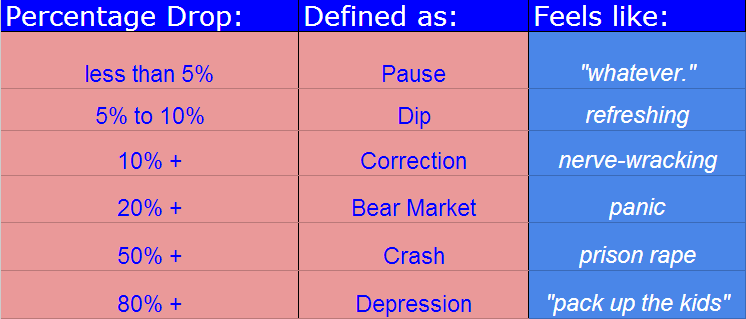
After a great 2013 with the S&P 500’s total return percentage in the high 20’s, it’s a good time to revisit your risk tolerance. The sleep-at-night factor is key to long-term investing success. Even if you have a good process and strategy, you need to be able to resist the urge to sell during a downturn. The following chart from Josh Brown is helpful in simulating the emotions felt during a selloff. Ask yourself, can you take the pain? If not, you better lighten up while the sun is shining.

JBselloffchart

(h/t Josh Brown)